When people think about pharmaceutical packaging, tablet counting often comes to mind first, since it is the stage where accuracy is most visible. A miscount can mean an underfilled or overfilled bottle, which creates problems for compliance, patient safety, and brand trust. However, counting is just one part of a much longer sequence of operations that together determine whether a packaging line actually performs well.
Understanding how counting fits into this broader workflow helps manufacturers see where real reliability comes from, and where it tends to break down.
Understanding the Purpose of Tablet Counting
Tablet counting exists to ensure that each bottle leaving the production line contains the exact number of tablets stated on its label. This is not simply a matter of convenience, it is a regulatory requirement in most markets, and even small deviations can trigger quality holds or recalls. Counting systems typically rely on sensors, vibratory feeders, or slot based mechanisms to track tablets as they move toward the bottle. The technology has improved over the years, but the underlying goal has not changed, every bottle must match its label, every time.
What is easy to overlook is that counting accuracy depends heavily on conditions upstream of the counter itself. Tablet shape, friability, static charge, and even ambient humidity can all affect how consistently tablets pass through a counting mechanism. So while counting is often treated as a standalone checkpoint, its performance is actually shaped by decisions made earlier in the process.
What Happens Before and After Counting
Before a tablet ever reaches a counter, it has already passed through compression, coating in some cases, and bulk handling. Any inconsistency introduced during these earlier stages, such as uneven tablet size or surface debris, can cause counting errors that have nothing to do with the counter itself. This is why manufacturers who focus exclusively on counting equipment sometimes find that their error rates do not improve as expected.
After counting, tablets move into filling, capping, labeling, and often secondary packaging such as cartoning. Each of these stages introduces its own variables. A bottle that receives the correct tablet count can still fail quality control if the cap seal is inconsistent or the label is misaligned. Reliability, in other words, is not the product of one perfect station, it is the result of every station working in coordination with the others.
How Equipment Choices Shape the Wider Workflow
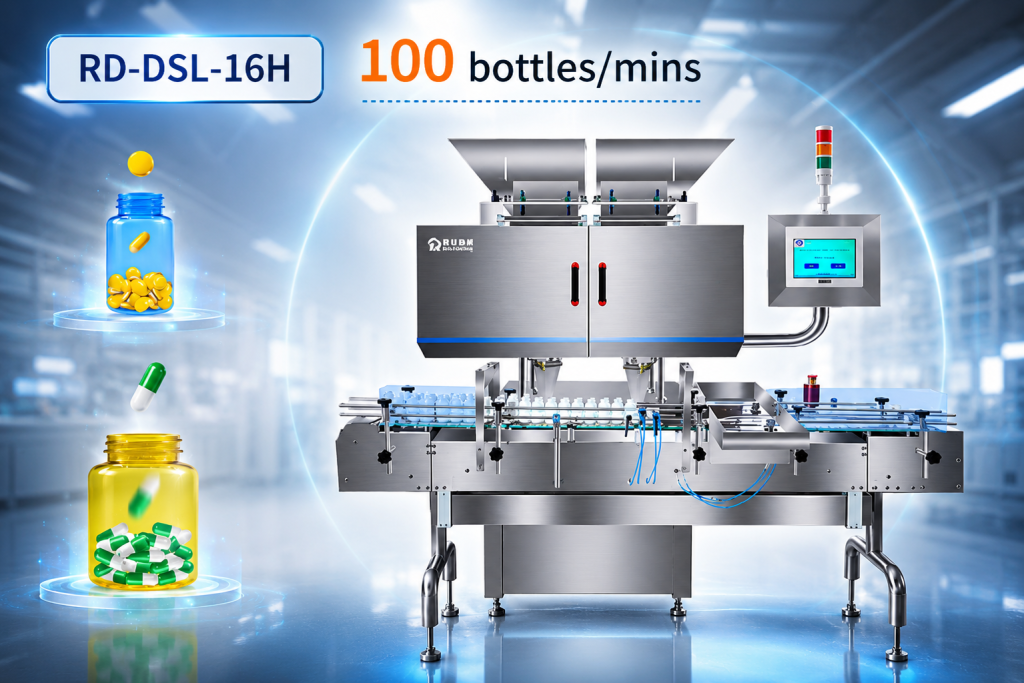
Equipment selection plays a meaningful role in how smoothly these stages connect. A tablet counting and filling machine, for example, combines two functions that are closely related but mechanically distinct, counting tablets accurately and depositing them into bottles without damage or spillage. When these two functions are handled by separate, poorly synchronized systems, manufacturers often see bottlenecks, minor jams, or timing mismatches that slow the entire line.
Integrating counting and filling into a single coordinated unit can reduce some of these friction points, since the transfer between counting and filling happens within a controlled mechanical sequence rather than across separate machines with different speeds or calibration settings. This does not eliminate the need for proper upstream tablet handling or downstream quality checks, but it does remove one common source of variability. The choice of equipment should be considered in the context of the full line, not as an isolated decision, since a machine that performs well on its own can still create inefficiencies if it does not match the pace or layout of adjacent stations.
Quality Checks That Support Consistency
Reliable packaging workflows depend on checks that occur at multiple points, not just at the counting stage. Weight verification, for instance, is often used as a secondary confirmation of count accuracy, since a bottle with the correct tablet count should also fall within an expected weight range. Vision systems are increasingly used to detect broken or chipped tablets before they reach the bottle, which addresses a quality issue that counting alone cannot catch.
Documentation also plays a role here. Batch records, calibration logs, and maintenance schedules all contribute to a packaging line’s overall reliability, even though they are not part of the physical production process. A counting machine that has not been recalibrated on schedule, for example, may continue to count tablets without any visible sign of error, even as its accuracy gradually drifts. Consistency, in this sense, is maintained through procedures as much as through equipment.
Coordinating People, Process, and Technology
Even well designed equipment requires trained operators who understand how to monitor performance and respond to early signs of trouble. Operators who can recognize subtle changes, such as a slight increase in tablet jams or inconsistent fill speeds, often catch problems before they affect output quality. This human oversight remains an important part of the workflow, regardless of how automated the line becomes.
Process design also matters. Decisions about line speed, batch size, and changeover procedures all influence how counting and filling operations perform in practice. A line optimized for long, uninterrupted runs may behave differently during frequent product changeovers, which is common in facilities producing multiple tablet formulations. Understanding these patterns allows manufacturers to adjust workflows proactively rather than reactively.
Conclusion
Tablet counting will always be a critical checkpoint in pharmaceutical packaging, but treating it as the sole determinant of line reliability overlooks how interconnected these processes really are. Upstream tablet quality, equipment integration, ongoing calibration, and trained oversight all contribute to consistent outcomes. A tablet counting and filling machine can help streamline part of this sequence by reducing transfer related errors, yet its value is realized only when it operates within a well coordinated workflow. Manufacturers who evaluate their packaging lines holistically, rather than focusing on counting in isolation, are generally better positioned to identify where inefficiencies originate and how to address them in a lasting way.